

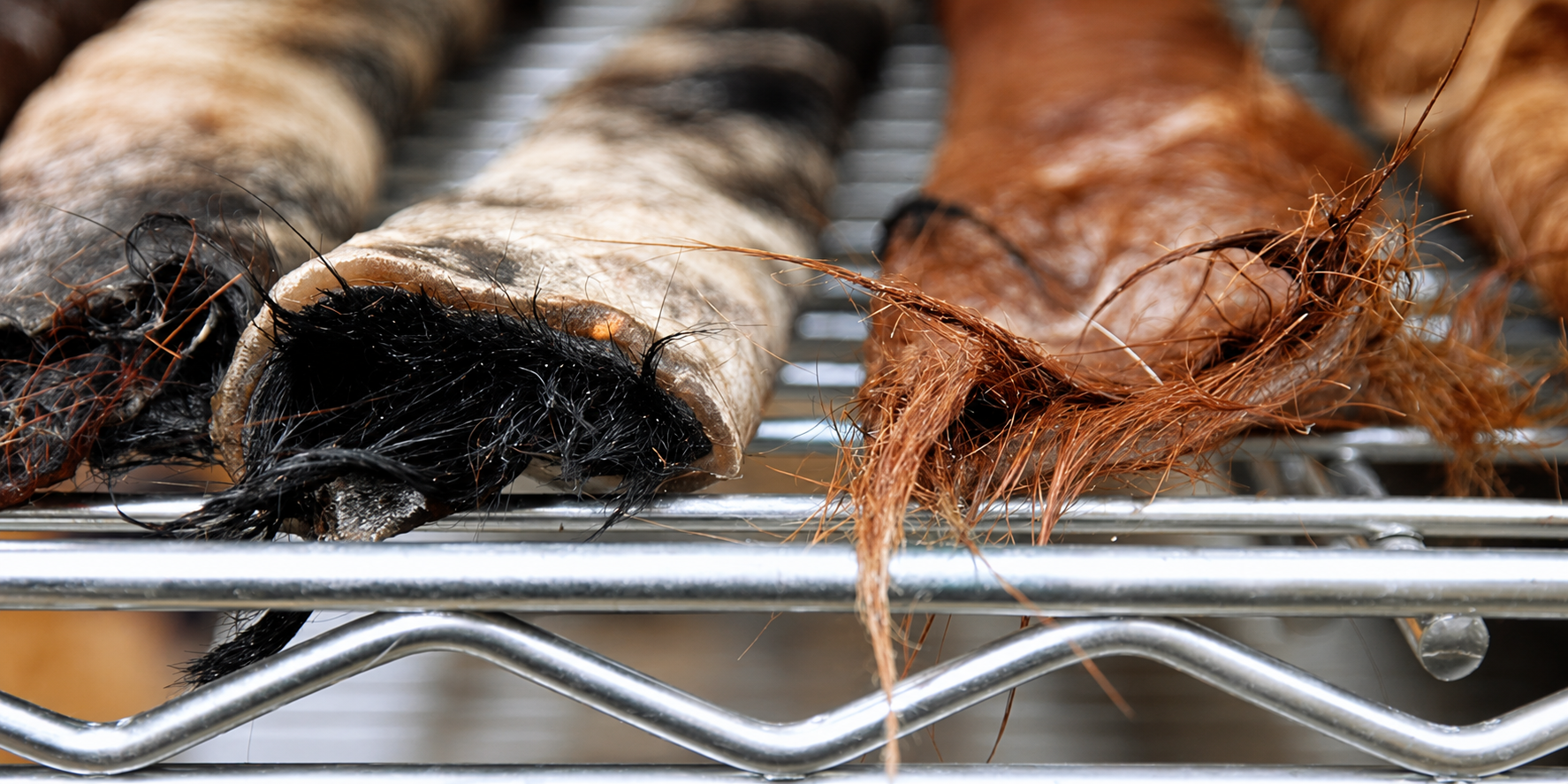
If you’ve seen hair-on hide rolls for dogs, you might be wondering, “Should I buy these for my dog? Are they safe, and why do they still have fur on them?”
Many dog owners have the same questions before trying this natural chew. Hair-on hide rolls have started to gain popularity because they are less processed than regular rawhide rolls and are made of the complete hide of the animal, along with the hair still intact. These can help keep your pet entertained and satisfy its chewing urges. In this article, you will be learn briefly how they’re made, whether they’re safe, and the benefits they can offer your dog.
What are hair-on hide rolls for dogs?
Hair-on hide rolls for dogs are single-ingredient dog chews made from whole, un-split animal skin with the fur left intact. Unlike traditional rawhide, which is chemically split, bleached with hydrogen peroxide, and glued together with artificial binders, these rolls are a pure whole food.
At Ugly Chews, things are done differently. Our treats preserve 100% of their natural thickness and organic nutrients. They are simply cleaned with hot, high-pressure water and dehydrated without toxic chemical baths. This process creates a fully digestible rawhide substitute that safely satisfies your dog's ancestral instinct to chew.
Are hair-on hide rolls safe for dogs to chew?
Yes, hair-on hide rolls are highly safe for dogs because they are fully digestible. They break down naturally in the stomach's acidic environment without swelling, and utilize precise thermal dehydration. And it gets rid of such dangerous bacteria as Salmonella and Listeria.
Traditional rawhide is infamous for being able to cause fatal stomach blockage due to chemical treatment. This makes the collagen absolutely immune to digestion by the dog's stomach acids. Once the dog swallows the traditional commercial rawhide, it swells in his stomach as an indigestible sponge.
In contrast, dehydrated dog treats like whole hide rolls break down smoothly. As they have not been chemically tanned, the hide will be digested by natural stomach enzymes. Thus, it is a great product for aggressive chewers. If your dog prefers something softer, alternative products, such as Thin Hides, offer him this digestive treat.
Where does the hide and fur come from?
High-quality hides are sourced from clean, grass-fed animals raised on sustainable farms. This validates a healthy life completely free from steroids or chemical antibiotics for dogs. Our pet treats began as a rural concept in reducing waste. Nowadays, we take full responsibility in providing our pets with eco-friendly treats with transparency in the sourcing of our ingredients.
The unique cleaning process at Ugly Chews solves the contamination issue cleanly. The hides are cleansed through high-pressure and hot-water washes and sterilized through ultraviolet light treatments as opposed to chemical treatments. Through the continuous holding of the hide at a bacteria-killing temperature for several days during the process of dehydration, all traces of moisture in it are taken out.
What are the intestinal health benefits of fur for dogs?
Consuming animal fur provides critical intestinal benefits by acting as a natural gut brush that clears waste, aids anal glands, and adds minerals.
Leaving the hide of the beef covered with its fur gives rise to four main foundations of good dog digestive health:
-
Mechanical Natural Deworming Agent: The fur gets ingested into the intestines as part of the structural fiber and functions as a gentle natural brush that cleanses the microorganisms and eggs of worms from the intestine walls.
-
Deep Colon Cleansing: The fibrous texture of the hair gently scrubs the colon walls, removing old food residue and stagnant mucus buildup to optimize your dog’s daily nutrient absorption.
-
Firmer Stools and Anal Gland Health: The hair adds natural, non-fermentable bulk to the feces, which applies natural pressure against the anal sacs to assist with effortless anal gland expression.
-
Native Manganese Supplementation: Animal hair is naturally rich in manganese, making single-ingredient dog chews with fur one of the easiest ways to supplement bioavailable manganese for dogs for joint and ligament health.
How do you safely introduce furry chews to your dog?
Begin with small bits of the chews and keep an eye on your dog while munching on the chew until you can see that it has become too small to be swallowed by the dog. Always get treats that have been appropriately treated by a reputable pet brand.
Preparation and Selection
-
When you are buying chews for your pet, you need to select the size. You should purchase chews that're larger than your pet's mouth so that your pet cannot swallow them.
-
You have to supervise the session. Always watch your pet while your pet chews to prevent your pet from choking.
-
You should take away the chews soon. Take the remaining piece of the treat away once it becomes small enough for your pet to swallow.
Feeding Safety Practices
-
Start with a piece of the treat on the first day when you are giving the treat to your pet.
-
Check whether your pet has an upset tummy, diarrhea, or vomiting.
-
You have to restrict the time. Allow your pet to chew the treats for 10 to 15 minutes.
-
Ensure that clean water is always nearby for your pet to drink.
Conclusion
Modern dog care is returning to evolutionary roots. Real, single-ingredient choices from Ugly Chews bridge the gap between durable entertainment and deep digestive therapy. By selecting treats derived from transparent, clean sourcing, you provide your dog with a tough chew that cleans their teeth, feeds their joints with manganese, and purges their digestive tract safely. Ditch the bleached chemicals of the past. Switch to a cleaner, species-appropriate chew that supports your pet from the inside out.
People also ask:
Can puppies safely eat hair-on hide rolls?
Yes, hair-on hide rolls are generally safe for puppies from 12 weeks of age onwards because the natural hide and fur act as fully digestible, soft fiber.
Can furry dog treats replace my dog's chemical dewormer?
No, furry dog treats are an excellent preventative digestive aid that helps physically flush out pests, but they do not chemically kill worms or replace veterinary medicine.
How often should I give my dog a hair-on hide chew?
Most pet nutritionists recommend giving your dog a hair-on hide chew 1 to 3 times per week to achieve the best dental and digestive benefits.
Do hair-on hide rolls have a strong or bad smell?
No, high-quality hair-on hide rolls have a very mild, naturally earthy scent and will not stink up your indoor living spaces.


