

Compare long lasting dog chews by dividing what you actually pay by the supervised chewing sessions your dog gets—not by the number of pieces in the bag. Count only sessions in which the chew remains appropriate for your dog; a leftover piece you must discard is not extra value.
- Compare long lasting dog chews by cost per supervised session, not package size or promised chewing time.
- Uglychews whole-hide dog chews suit owners prioritizing single ingredients and Wyoming-made products; supervision remains essential.
- Track active chewing, condition, and discarded leftovers before deciding which chew gives your dog better value.
- Choose appropriate size and thickness first. A lower cost per session never cancels choking, blockage, or dental risks.
Why this matters
A chew that looks substantial can still be a poor purchase for your dog. If your dog ignores it, tears off swallowable pieces, or needs it removed immediately, the amount left in the bag tells you little about value.
Buy for the dog in front of you, not the longest-lasting claim on the label. Your first purchase should establish ingredient fit, appropriate sizing, and chewing behavior before you compare repeat purchases.
For your 2026 buying checklist, separate where a chew is made from where its ingredients originate. These sourcing questions for US-made dog chews help you ask about both without treating a country-of-origin statement as a safety guarantee.
How do you compare cost per session for long lasting dog chews?
Cost per session equals your actual purchase cost divided by the supervised sessions the chew provides. This is a record of your dog's experience, not a durability prediction for another dog.
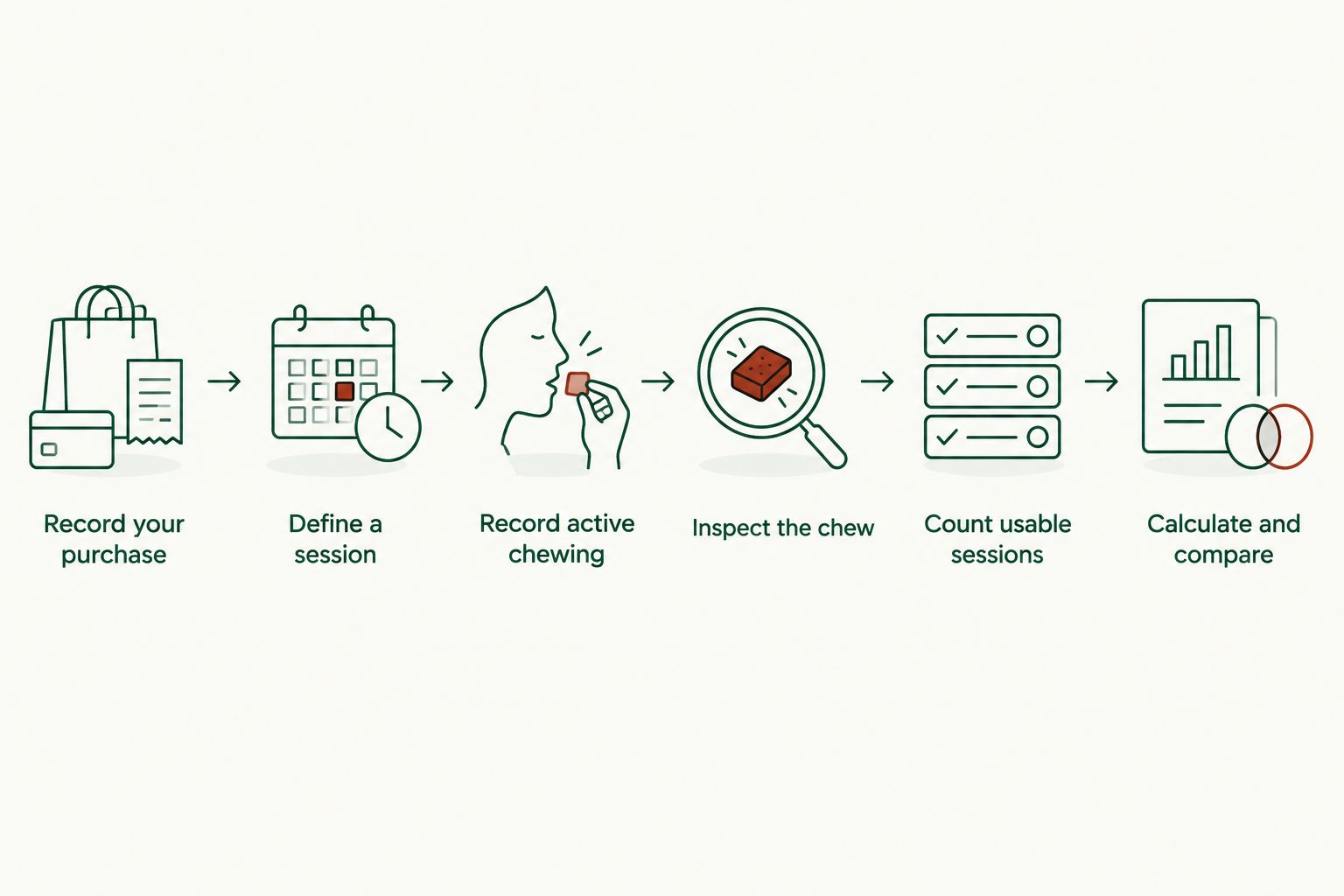
Use this sequence before calling any chew a better buy:
- Record your purchase. Use the amount actually paid for the chews you are comparing. Handle shipping and other order charges consistently across purchases.
- Define a session. Count an actual period of supervised chewing, not every time your dog briefly picks up the chew.
- Record active chewing. Use a timer or note the start and finish. Separate chewing from carrying, hiding, or ignoring the piece.
- Inspect the chew. Watch for changes in size, loose pieces, and your dog's attempts to swallow sections. Remove it when it is no longer appropriate.
- Count usable sessions. Include later sessions only when storage and reuse follow the product's instructions and the chew remains suitable.
- Calculate and compare. Divide the purchase cost by the sessions recorded. Keep rejection and discarded pieces visible in your notes.
If a dog never uses a chew, do not divide by zero or describe it as excellent value because it remains intact. Record it as an unused purchase. That is a useful result, too.
Keep session value separate from chewing time
Cost per session answers how often a purchase gives your dog an appropriate chewing opportunity. Cost per active chewing minute answers a different question: how much chewing time that purchase provides.
Neither measure proves safety. A dog that spends longer chewing something unsuitable has not turned it into a good choice. Record why each session ended alongside its duration so the total does not hide a problem.
Whole-hide rolls or thin hides: which should you compare first?
For a first order, compare format before chasing maximum thickness. Uglychews makes single-ingredient, hand-cut whole-hide dog chews in Wyoming; that gives ingredient-focused shoppers specific facts to evaluate, not a promise about session length.
Uglychews whole-hide dog chews are best for owners who prioritize single ingredients and Wyoming-made products. The limitation is straightforward: those facts do not establish how long a particular dog will chew or whether a particular piece fits that dog.
| Whole-hide option | Best for | Verified detail | Trade-off to assess |
|---|---|---|---|
| Hair-On Hide Rolls | Owners seeking whole beef hide with hair retained | Whole beef hide, hair rolled inside, hand-cut from full-thickness cowhide | Full thickness does not establish an appropriate size or predictable session count for your dog |
| Thin Hides | Owners specifically considering a thinner hide format | Rolls that dry thinner than anticipated during preparation | A thinner format is not a safety rating or a guaranteed match for a small dog |
Do not assume that thicker automatically means better value or that thinner automatically means easier chewing. Watch how your dog handles the actual piece. Grip, tearing, gulping, and willingness to chew matter more than a format name.
Hair-On Hide Rolls: evaluate the whole-hide format
Hair-On Hide Rolls contain whole beef hide with the hair rolled inside and nothing else, according to the supplied product description. That makes the ingredient choice straightforward for an owner who wants to know what the chew contains.
The unanswered question is session performance for your dog. Inspect the dimensions offered, choose an appropriate piece, and record what happens during supervised use. Do not convert full thickness into an assumed number of sessions.
Thin Hides: evaluate thickness without assuming suitability
Thin Hides are rolls that dry thinner than anticipated after cleaning, cutting, and drying. Consider that format when comparing thickness, but keep size selection separate from thickness selection.
A thin piece can still be inappropriate in size or become swallowable. If your dog folds, tears, or tries to gulp it, the purchase has not earned another session simply because some hide remains.
Once you have chosen the format to evaluate, these are the corresponding products. Check the current listing for selection details rather than guessing from the photo.


Why cost per chewing session varies
Your own records explain value better than a universal longevity claim. Keep these factors visible when comparing purchases in 2026:
- Chewing behavior. Steady gnawing, tearing, and attempts to swallow chunks produce different outcomes. Record the behavior, not just elapsed time.
- Piece size and thickness. Different dimensions give your dog different pieces to handle. A product name alone does not tell you whether the piece is appropriate.
- Interest. A chew your dog leaves untouched does not provide a session, regardless of how substantial it looks.
- Removal point. Discarded ends and damaged pieces belong in the value calculation. Never extend use to improve the result.
- Purchase accounting. A delivered-order total and a product-only total measure different costs. Choose an approach and use it consistently.
- Reuse instructions. A partly chewed piece is not automatically suitable for another session. Follow the product's storage guidance and discard questionable material.
Avoid changing the rules halfway through a comparison. If you counted delivery charges for the first purchase, count them for the next. If you stopped the timer while your dog wandered away, keep doing that.
How do you choose a size without guessing chewing time?
Choose dimensions for appropriate handling, not for a promised duration. A length measurement tells you how long a piece is before use. It does not tell you how your dog will handle it as the shape changes.
The listed Ultimate Sample Bundle includes Hair-On Hide Roll lengths of 12 inches, 8 inches, and 4 inches. Those are product dimensions—not chewing-time estimates, dog-weight recommendations, or proof that every piece suits the same dog.
Before offering a chew, check:
- Can your dog take the whole piece into its mouth?
- Does your dog chew steadily or attempt to gulp?
- Does the piece develop loose sections during chewing?
- Can you stay close enough to notice changes and remove it?
Do not assign a dog to a size solely because the listing says small, medium, or large. Ask the seller about dimensions and your veterinarian about suitability when dental history, swallowing behavior, or dietary restrictions complicate the choice.
What should you record during your first purchase?
Use a simple 2026 chew log rather than relying on memory. Keep observations specific enough that you can compare the next order without rewriting the rules.
| Log field | What to write down | What it helps you decide |
|---|---|---|
| Product and format | Exact product name and selected dimensions | Whether you are comparing like with like |
| Purchase cost | Actual amount paid using a consistent accounting method | What enters the session calculation |
| Active chewing | Observed chewing time, excluding breaks | Whether a session delivered actual chewing |
| Session ending | Lost interest, owner ended session, or chew removed | Why the timer stopped |
| Remaining piece | Condition, loose sections, and discarded material | Whether a later session is appropriate |
| Dog response | Gulping, discomfort, or digestive changes | Whether to stop and seek veterinary advice |
Do not turn the log into a challenge to make a chew last longer. It is a buying tool. If the entry says the piece became unsuitable, the useful next step is removal—not another trial to rescue the calculation.
Is the longest-lasting chew always the best value?
The longest-lasting chew is not automatically the best value. Duration matters only after ingredient fit, appropriate sizing, your dog's behavior, and supervision are addressed.
A chew that lasts because your dog avoids it is not doing the job you bought it for. A chew that keeps your dog occupied but encourages gulping is not a bargain either. Reject unsuitable options before comparing their session totals.
For your 2026 repeat purchase, favor a format your dog handles appropriately over an impressive claim you cannot verify. Keep reviewing each piece; a previous good experience does not remove the need to supervise the next session.
Should you compare liver treats with whole-hide chewing sessions?
Use liver treats for a treat comparison, not as a substitute measure for whole-hide chewing value. The supplied Freeze Dried Liver Bites description identifies single-ingredient freeze-dried liver treats; it provides no session-duration evidence.
Whole-hide chews and small rewards serve different buying purposes. Compare a chewing purchase against the supervised chewing opportunities it provides. Compare a reward purchase against the reward use you actually need, without pretending the same metric answers both questions.
FAQ
What's the best way to compare long lasting dog chews?
Compare actual purchase cost divided by supervised chewing sessions, then check active chewing time and why each session ended. Exclude options that are unsuitable for your dog before judging value.
How much does each chewing session cost?
Your cost per session is the amount you paid divided by the supervised sessions your dog actually gets. There is no supported universal session cost or duration for these products.
Are thicker dog chews always better value?
Thicker dog chews are not automatically better value. Appropriate size, your dog's chewing behavior, interest, and the point at which you must remove the piece determine whether the purchase works.
What sizes are listed for the whole-hide rolls in the sample bundle?
The Ultimate Sample Bundle lists Hair-On Hide Roll lengths of 12 inches, 8 inches, and 4 inches. Those measurements do not establish dog-weight suitability or chewing duration.
Can I give my dog the same hide chew again later?
Reuse depends on the product's instructions and the condition of the partly chewed piece. Follow storage guidance and discard questionable, damaged, or swallowable remnants rather than saving them to lower session cost.
Are natural or US-made dog chews risk-free?
Natural or US-made dog chews are not risk-free. Choking, blockage, dental injury, and bacterial risks still require appropriate selection, supervision, and handling.
Who are Uglychews whole-hide dog chews best for?
Uglychews whole-hide dog chews are best for owners who prioritize single ingredients and Wyoming-made products. Those details do not guarantee chewing duration or remove the need for supervision.
One last thing
The most useful entry in your chew log is why you took the chew away. Duration alone cannot distinguish a satisfying session from a piece that quickly became inappropriate.
For your next 2026 purchase, read that entry before reordering. Buy the format that fits your dog's observed behavior, and let the session calculation help you compare the suitable choices—not talk you into keeping an unsuitable one.


