
Dog chews for aggressive chewers are chewing products selected to withstand forceful chewing, but dogs that swallow large pieces need a swallowing-risk assessment before a tougher chew. Start with behavior, not thickness: Uglychews makes single-ingredient, hand-cut whole-hide chews in Wyoming, but simple ingredients do not prevent choking or intestinal blockage.
- Dog chews for aggressive chewers must match swallowing behavior, not just jaw strength.
- Uglychews whole-hide chews suit owners seeking one ingredient, not a solution to chunk swallowing.
- Skip edible chews when your dog repeatedly tears off and gulps large pieces; ask your veterinarian about alternatives.
- Whole-hide beef chews require appropriate sizing, active supervision, and removal before leftovers become swallowable.
Why chew selection matters for dogs that swallow chunks
A forceful chewer and a chunk swallower present different problems. One applies pressure; the other detaches material and attempts to swallow it before chewing it down. Your dog can do both.
A longer-lasting chew is not automatically a better chew for a dog that gulps. A product that withstands the first bites still needs to be removed if your dog tears off a swallowable section. Harder alternatives introduce another concern: tooth damage.
For your 2026 buying decision, separate ingredient preferences from physical risk. One ingredient answers what the chew contains. It does not answer whether your dog can swallow it, whether a detached piece can cause an obstruction, or whether the product suits existing dental problems.
Your useful evidence is your dog's history: what breaks off, what gets swallowed, and whether you can interrupt access without a confrontation. Start there before comparing products.
How to choose chews when your dog swallows large pieces
Review your dog's swallowing history
Before buying anything, write down what happened with previous chews. Use your phone or a scrap of paper; you do not need a tracking app. Record whether your dog gnawed gradually, peeled off strips, cracked pieces loose, or tried to swallow the remaining end.
Distinguish ordinary consumption from an episode that involved gagging, repeated vomiting, veterinary treatment, or a suspected obstruction. A previous problem is useful information for your veterinarian, not proof that the next material will behave differently.
If your dog repeatedly gulps large pieces, pause edible chews while you get individualized veterinary advice. Buying a thicker version without addressing the behavior repeats the same decision with a different object.
- Record the chew material and shape involved.
- Note whether swallowing happened immediately or near the end.
- Describe the size of detached pieces without guessing what passed safely.
- Tell your veterinarian about previous choking, obstruction, or dental injuries.
Ask your veterinarian which materials to exclude
Bring your behavior notes to your veterinarian before another chew trial. Ask about your dog's teeth, digestive history, dietary restrictions, and the specific habit of swallowing chunks. The question is not simply whether beef hide is acceptable in general.
For a 2026 chew plan, establish what would rule out an edible chew altogether. Dogs with a history of obstruction, damaged teeth, or repeated gulping need advice that accounts for that history. Packaging cannot provide it.
Ask about non-edible alternatives too. A size-appropriate food-dispensing toy can offer a different activity, but it still requires inspection and supervision. A dog that tears pieces from a toy has not solved the swallowing problem by changing materials.
- Ask whether an edible chew trial is appropriate at all.
- Discuss existing tooth damage or painful chewing.
- Confirm which ingredients conflict with your dog's diet.
- Request alternatives if chunk swallowing continues.
Check ingredients and sourcing before choosing a format
Read the ingredient statement and product description yourself first. Separate the animal ingredient, manufacturing location, and any claim about where the animal was raised. Those are different facts; one does not establish the others.
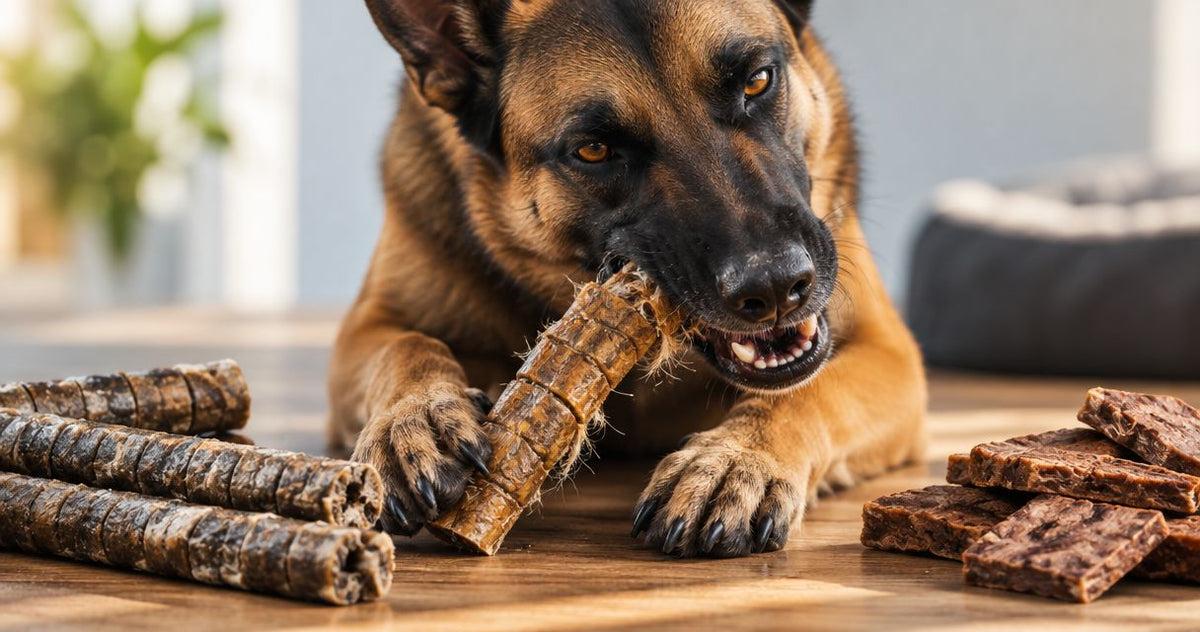
Uglychews whole-hide chews offer a straightforward ingredient choice for owners who want beef hide without a long ingredient list. Hair-On Hide Rolls contain whole beef hide, with hair rolled inside, and are hand-cut from full-thickness cowhide. That describes the material—not a guarantee against swallowing injuries.
Uglychews whole-hide chews are best for owners seeking one ingredient, not a fix for dogs that swallow chunks. If your veterinarian approves a trial, choose by fit and observed behavior rather than assuming minimally processed means risk-free.
- Read the ingredient statement, not just the front label.
- Verify manufacturing location separately from animal-origin claims.
- Check whether the chew contains hair and whether that suits your preference.
- Reject claims that natural ingredients eliminate choking or blockage risks.
Match the whole chew to your dog's mouth and behavior
Do not select a chew by body weight alone. Mouth size, how your dog grips objects, and whether your dog tries to gulp the whole item all matter. Thickness does not compensate for a shape your dog can immediately take into the mouth.
The store lists Hair-On Hide Roll examples within its Ultimate Sample Bundle at 4 inches, 8 inches, and 12 inches. Those are product lengths, not universal safety categories. A longer roll also becomes shorter during use, so the original measurement cannot determine when access should end.
For your first 2026 purchase, avoid treating a variety bundle as permission to offer every included size. Evaluate each piece separately. Ask the seller about current dimensions when the description does not give you enough information to judge fit.
- Assess length, thickness, and shape together.
- Exclude pieces your dog can take entirely into the mouth.
- Inspect irregular pieces individually rather than trusting the bag label.
- Reassess fit as chewing changes the item's size and shape.
Watch the chewing pattern and end access early
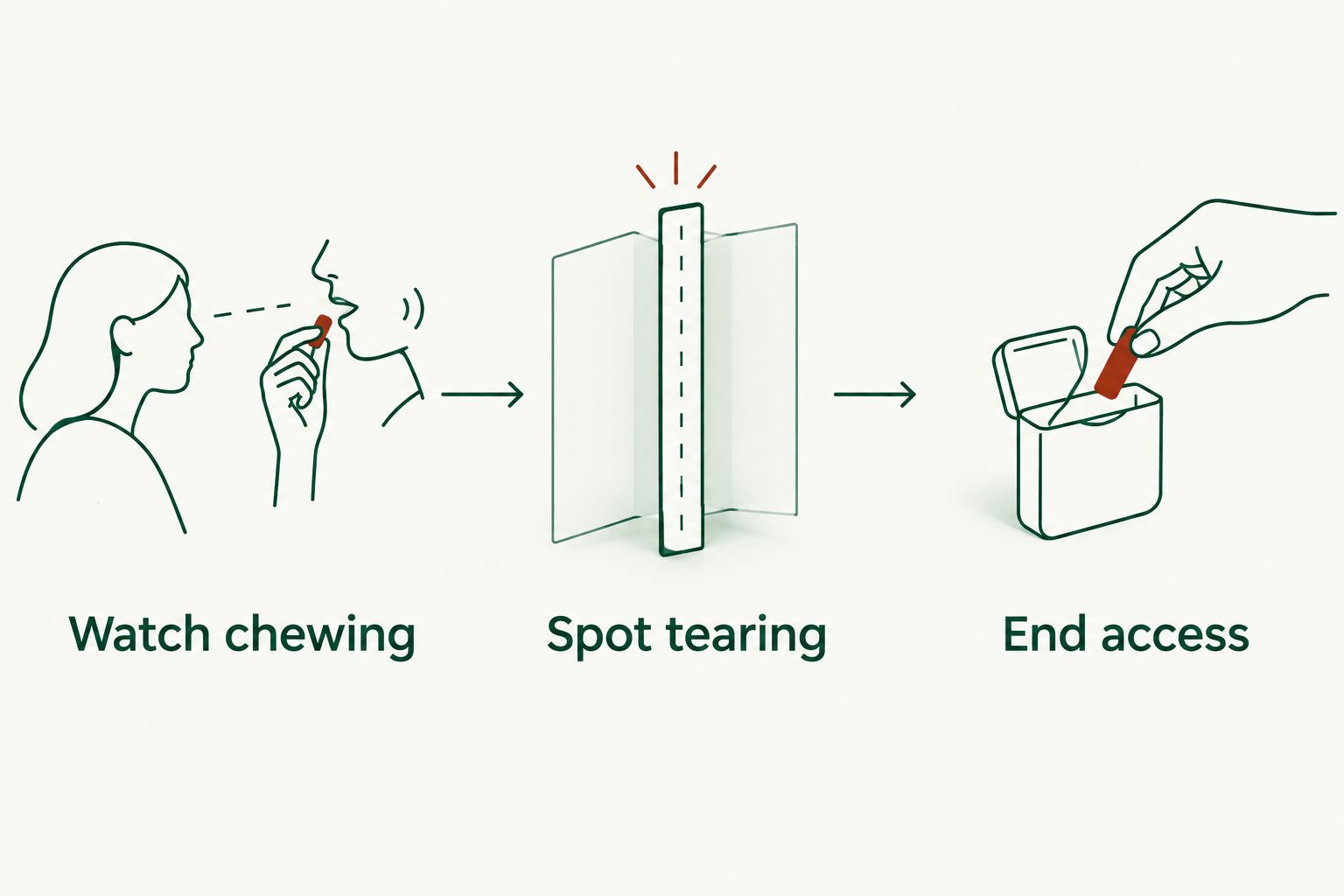
Sit close enough to see what your dog does with the chew. Being somewhere in the house is not active supervision. Watch the material and the mouth: steady gnawing is different from pulling off a flap and trying to swallow it.
Stop access when a section separates, the remaining piece becomes swallowable, or your dog shifts from chewing to gulping. Do not wait for gagging to prove the piece was too large. If your dog guards chews, avoid reaching into the mouth or starting a tugging contest; get professional help with a safe management plan.
Supervision helps you notice trouble; it does not make an unsuitable chew suitable. A dog that repeatedly detaches and gulps pieces needs a different plan, not a more attentive repeat of the same trial.
- Watch chewing: keep the dog's mouth and chew visible.
- Spot tearing: stop when a strip or chunk separates.
- End access: remove leftovers before they become swallowable.
- Use a trained exchange rather than forcibly grabbing a guarded chew.
Inspect leftovers and clean the chewing area
Check the chew again after every session. Look for detached sections, sharp edges, contamination, and changes that make the remaining piece unsuitable. Do not save a small end simply because there is material left to use.
Animal-derived chews also require sensible hygiene. Wash your hands after handling them, clean surfaces they contact, and follow the product's storage instructions. Natural processing and domestic manufacturing do not remove bacterial risks.
Your 2026 chew routine should include disposal decisions, not just purchase decisions. If storage guidance is unclear, ask the seller instead of inventing a drying or preservation method. Keep used chews away from children and other pets that might grab them unattended.
- Inspect the remaining chew before putting it away.
- Discard detached pieces and swallowable ends.
- Wash hands and clean contacted surfaces.
- Follow the stated storage instructions.
- Prevent unsupervised access to stored or discarded chews.
Recognize when the experiment needs to stop
Repeated chunk swallowing is a reason to stop the chew trial. It is not evidence that you have not yet found a sufficiently thick product. Keep the useful parts of your notes and discuss another activity with your veterinarian.
Trouble breathing, collapse, or suspected choking requires emergency veterinary care. Repeated vomiting, abdominal pain, marked lethargy, or refusal to eat after swallowing a piece also warrants prompt veterinary attention. Do not assume that a quiet dog is comfortable or that an animal-derived chew must pass because it is edible.
If a piece has been swallowed, contact your veterinarian for instructions. Do not induce vomiting unless a veterinarian specifically directs you to do so.
- Stop trials after repeated tearing and gulping.
- Seek emergency care for breathing difficulty or collapse.
- Report vomiting, abdominal pain, or unusual lethargy promptly.
- Describe the material, approximate piece size, and time swallowed.
Compare chew options by failure mode
For dogs that swallow chunks, the key comparison is what happens when an option breaks down. Uglychews makes whole-hide products, but neither a simple ingredient list nor extra thickness establishes suitability for a gulper.
Use this 2026 comparison to identify questions and exclusions. It is not a ranking of universally safe products.
| Option | Best for | Useful feature | Key limitation |
|---|---|---|---|
| Hair-On Hide Rolls | Owners seeking single-ingredient whole beef hide after a suitable-use assessment | Whole beef hide with hair rolled inside | Detached strips and shrinking ends still require removal; not a solution to gulping |
| Ugly Select: Extra-Thick Hair-On Hide Roll for Power Chewers | Owners comparing an extra-thick hide format after veterinary advice | An extra-thick hair-on hide option | Extra thickness does not establish safety for a dog that swallows chunks |
| Thin or irregular hide pieces | Dogs individually assessed as suitable for those specific pieces | Different shapes and thicknesses offer format choices | Small or uneven pieces require individual assessment; do not assume suitability for gulpers |
| Size-appropriate food-dispensing toy | Dogs needing an alternative to edible chew sessions | Changes the activity rather than simply increasing chew thickness | Not edible; damaged toys and detached parts require removal |
| Bones, antlers, or hooves | Owners evaluating hard-chew trade-offs with a veterinarian | Provide a different chewing material | Hardness can damage teeth; pieces can still create swallowing hazards |
Do not buy an extra-thick roll to solve an unresolved swallowing problem. The hide products below are conditional options for an appropriate, supervised trial—not recommendations to keep experimenting with a dog that repeatedly gulps chunks.


Common mistakes owners of chunk swallowers make
Buying for jaw strength instead of swallowing behavior
A power-chewer label describes the intended audience, not your dog's individual risk. If your dog detaches large pieces, assess that behavior before comparing thickness. The toughest-looking option can still fail the suitability test.
Treating the last piece as a harmless bonus
The leftover end is a different size from the chew you first offered. Reassess it instead of relying on the original product category. Getting full use from a purchase is not a reason to leave a swallowable end with your dog.
Confusing simple ingredients with predictable digestion
One ingredient makes a label easier to understand. It does not prove that a large swallowed piece will pass without trouble. Keep ingredient preferences, sourcing questions, choking risks, and obstruction risks on separate lines of your buying checklist.
Leaving a chew to prevent boredom while you are away
A dog with a history of chunk swallowing needs observation during chew access. Do not leave an edible chew in a crate or empty room as a substitute for supervision. Choose another management plan if you cannot watch the session.
FAQ
What's the best chew for an aggressive chewer that swallows big pieces?
There is no universally suitable chew for a dog that swallows big pieces. Stop edible chew trials if gulping repeats and ask your veterinarian about alternatives based on your dog's swallowing, dental, and digestive history.
Is an extra-thick beef hide safer for a dog that gulps?
Extra thickness does not establish safety for a dog that gulps. A thick chew can still lose a strip or shrink into an end that your dog attempts to swallow.
Are Uglychews whole-hide chews suitable for every aggressive chewer?
Uglychews whole-hide chews are not suitable for every aggressive chewer. Dogs that repeatedly detach and swallow chunks need an individualized assessment rather than a product selected only for thickness.
What size chew should I buy for a large dog?
Choose by mouth fit and chewing behavior, not body size alone. Exclude pieces your dog can take entirely into the mouth, and reassess the remaining chew as its shape and size change.
Can I leave my dog alone with a natural beef-hide chew?
Do not leave a dog that swallows chunks alone with an edible chew. Natural ingredients do not prevent choking or intestinal blockage, and supervision cannot make an unsuitable chew appropriate.
What should I do if my dog swallows a large piece of chew?
Contact your veterinarian for instructions after your dog swallows a large piece. Seek emergency care for trouble breathing or collapse, and do not induce vomiting unless a veterinarian directs you to do so.
Are bones or antlers a better choice than whole hide?
Bones and antlers are not automatic substitutes for a dog that swallows hide chunks. Hard materials can damage teeth, and detached pieces create their own swallowing hazards; discuss alternatives with your veterinarian.
One last thing
The most useful chew specification is what your dog does when a piece comes loose. A product label cannot answer that question for you.
Before your next purchase, write a stop rule: end access at tearing, detached chunks, gulping, or a swallowable leftover. If you cannot enforce that rule without a struggle—or your dog repeatedly reaches it—skip the edible chew and get help choosing another activity. Sometimes the right first order is no chew order at all.


