

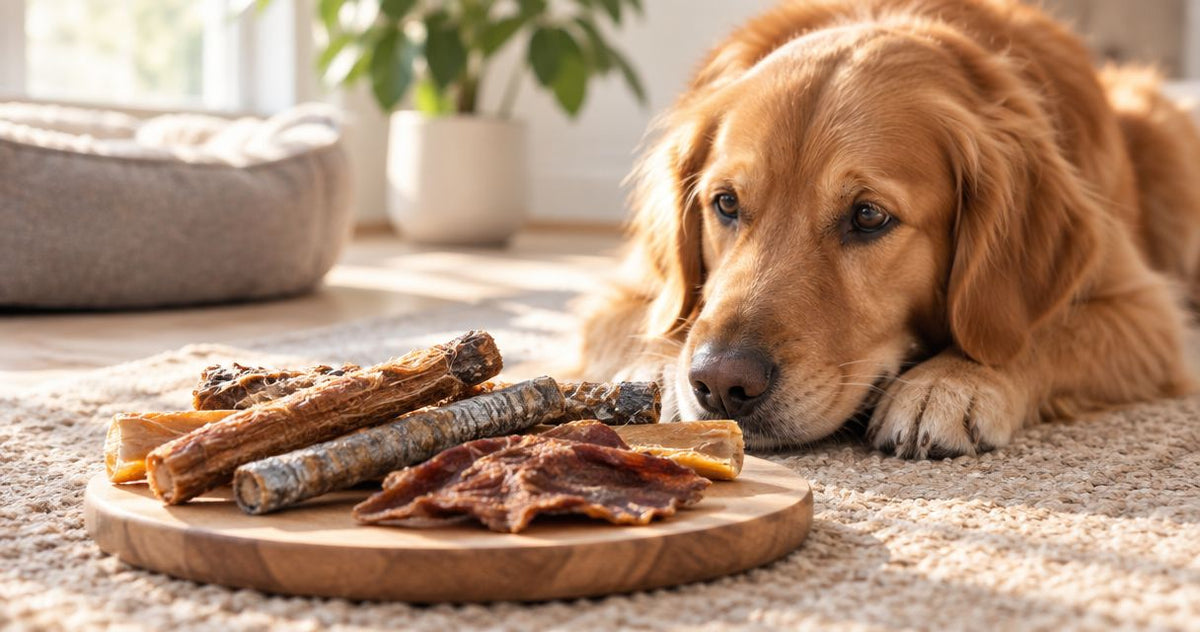
Best for a simple beef ingredient list: Hair-On Hide Rolls, only if your veterinarian agrees beef hide suits your dog. Best for a thinner hide format: Thin Hides, with the same caution. Best for avoiding another edible ingredient: an appropriately sized rubber chew toy. Natural dog chews for sensitive stomachs need to match the dog’s diet and chewing behavior—not just look good on a label.
- Uglychews natural dog chews offer a simple beef option, not a treatment for sensitive stomachs.
- Hair-On Hide Rolls suit ingredient-focused buyers only when beef hide fits their veterinarian’s advice.
- Thin Hides offer a thinner format, not proven easier digestion.
- Choose natural dog chews for sensitive stomachs by diet compatibility, size, and supervision.
- Pause edible chews during stomach upset or a prescribed diet trial unless your veterinarian approves.
Why this matters
A sensitive stomach is a description, not a diagnosis. Vomiting, loose stools, food intolerance, and food allergy do not all call for the same shopping decision.
Uglychews natural dog chews are best for owners seeking a simple beef ingredient list, not a sensitive-stomach treatment. The brand makes single-ingredient, hand-cut whole-hide chews in Wyoming. That tells you about ingredients and preparation; it does not establish that a particular dog will tolerate them.
For your 2026 purchase, separate two questions: does the ingredient fit your dog’s diet, and can your dog handle the physical chew? A familiar protein does not remove choking, blockage, dental, or bacterial risks.
What makes the best natural chews for sensitive stomachs?
Use these criteria before choosing a shape or filling a cart:
- Diet compatibility: Avoid ingredients your veterinarian has told you to exclude. Do not add an unapproved chew during a prescribed elimination diet.
- Clear ingredients: A short ingredient list makes it easier to identify what you introduced. It does not prove digestibility or tolerance.
- Specific sourcing: Distinguish where a chew is prepared from where its animal ingredients originate. Those are different claims.
- Appropriate size: Choose a chew your dog cannot swallow whole. Reassess as chewing changes its size and shape.
- Chewing behavior: A dog that gnaws needs a different decision from a dog that tears off and gulps pieces.
- Honest limitations: Skip promises of universal safety, allergy protection, or guaranteed stomach comfort without supporting evidence.
Made in Wyoming is not the whole sourcing answer
Uglychews states that its chews are made in Wyoming. The Hair-On Hide Rolls description identifies whole beef hide, hair rolled inside, and hand-cut, full-thickness cowhide.
If US sourcing is your priority, confirm the cattle’s origin separately. A manufacturing location alone does not establish every step of an ingredient’s origin, and neither domestic sourcing nor minimal processing removes chewing risks.
Natural dog chew options at a glance
This 2026 comparison separates ingredient simplicity from digestive suitability. The rubber option is a non-edible alternative, not a natural edible chew.
| Option | Best for | Standout feature | Key limitation |
|---|---|---|---|
| Hair-On Hide Rolls | Owners seeking a clearly described beef-hide chew | Whole beef hide with hair rolled inside | Not established as suitable for sensitive stomachs; swallowed hide can cause problems |
| Thin Hides | Owners specifically seeking a thinner hide format | Rolls described as drying thinner than anticipated | Thinness does not establish easier digestion or safe swallowing |
| Appropriately sized rubber chew toy | Dogs that should avoid another edible ingredient | Provides a chewing object without intentionally adding food | Pieces can still be swallowed; material and size need checking |
No option wins for every dog with digestive symptoms. If your dog is currently ill, the next move is veterinary advice—not a different chew.
1. Hair-On Hide Rolls: best for a simple beef ingredient list
Hair-On Hide Rolls contain whole beef hide with the hair rolled inside and nothing else, according to the product description. They are hand-cut from full-thickness cowhide.
That is useful information when you want to know exactly what you are offering. It is not evidence that beef hide is gentle on every stomach, that hair improves digestion, or that the chew belongs in a dog’s allergy-management plan.
Hair-On Hide Rolls pros:
- The description names the animal ingredient: beef hide.
- The stated recipe contains nothing else.
- The preparation details identify full-thickness hide and the position of the hair.
Hair-On Hide Rolls cons:
- Beef is unsuitable when your dog’s prescribed diet excludes it.
- No supplied product evidence establishes sensitive-stomach tolerance.
- Large swallowed pieces present choking or gastrointestinal obstruction risks.
Best for: An owner whose dog tolerates beef, whose veterinarian agrees hide chewing is appropriate, and who wants a straightforward ingredient list.
For your first purchase, ingredient clarity should come before toughness. Do not choose a hide simply because you want a longer chewing session, and do not treat hair as a digestive supplement.
Verdict: Buy only after confirming that beef hide fits your dog’s diet and chewing behavior; otherwise, skip.
2. Thin Hides: best for choosing a thinner hide format
Thin Hides are described as rolls that dry thinner than anticipated after the hides are cleaned, cut, and dried. Their distinct role is format—not a different medical or nutritional claim.
A thinner chew is not automatically easier to digest. It also does not automatically suit a small dog, a senior dog, or a dog that swallows pieces instead of chewing them.
Thin Hides pros:
- The description explains why these rolls differ from other hide formats.
- They give buyers an option when thickness is the specific selection criterion.
- They keep the purchase focused on hide rather than adding a mixed treat assortment.
Thin Hides cons:
- There is no supplied evidence that thin hide improves digestive tolerance.
- A thinner piece still requires careful sizing and supervision.
- Dogs that gulp softened pieces are not made suitable candidates by choosing thin hide.
Best for: Owners already cleared to offer hide who specifically want to assess a thinner format.
Do not introduce Thin Hides alongside several other new treats. Keeping the rest of your dog’s diet unchanged makes a new reaction easier to discuss with your veterinarian; it does not turn a home trial into a diagnosis.
Verdict: Hold until hide is an appropriate choice; buy for the format, not a sensitive-stomach promise.
Compare the actual hide options
These are the two relevant whole-hide choices discussed above. Neither carries a verified sensitive-stomach claim in the supplied product information.


3. Rubber chew toys: best for avoiding another edible ingredient
An appropriately sized rubber chew toy is a non-edible alternative when adding food is the problem. Leave it unfilled if your veterinarian wants your dog’s intake restricted to a prescribed diet.
Rubber is not a natural edible chew, and no toy is indestructible. This option belongs in the comparison because sometimes the right answer to a food-sensitive dog is not another food.
Rubber chew toy pros:
- An unfilled toy does not intentionally introduce a new food ingredient.
- You can inspect it during use and remove it when damaged.
- It separates chewing enrichment from offering an edible treat.
Rubber chew toy cons:
- Torn pieces can become choking or obstruction hazards.
- An unsuitable size or material can make the toy inappropriate.
- Fillings and flavored versions require their own ingredient review.
Best for: Dogs whose veterinary plan excludes additional edible chews, provided the individual toy suits their mouth and chewing behavior.
Check the manufacturer’s intended use and inspect the toy before and during each session. Remove damaged toys rather than waiting for a missing piece.
Verdict: Buy an appropriate option when food restriction is the priority; skip any toy your dog tears apart.
A first-purchase plan for 2026
Start with your dog, not the product photo. A chew that looks modest in a shopping cart can still be wrong for the mouth, diet, or dog in front of you.
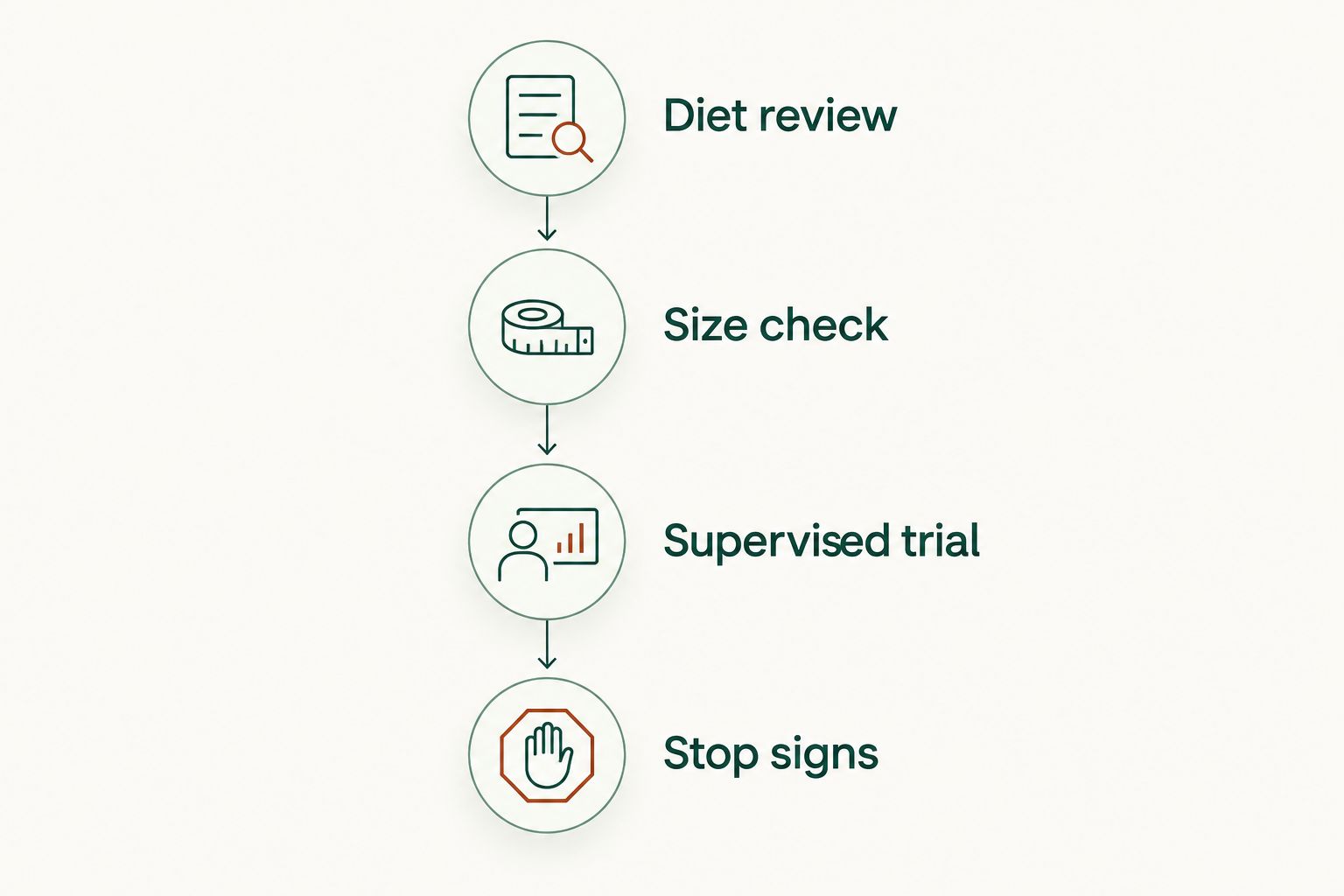
Use this sequence before introducing an edible chew:
- Diet review: Confirm that the ingredient fits the current feeding plan. Ask your veterinarian first if symptoms recur or your dog has a relevant medical history.
- Size check: Assess the actual piece, including width and shape—not just the length printed in a description.
- Supervised trial: Offer it when you can watch actively. Keep other new treats out of the introduction.
- Stop signs: Remove the chew if your dog tries to gulp it, tears off concerning pieces, or develops symptoms.
Keep the packaging and ingredient information so you can tell your veterinarian what your dog received. Do not invent a universal serving time or assume that finishing a chew without immediate symptoms proves future tolerance.
When to stop shopping and call your veterinarian
Do not introduce an edible chew during vomiting, diarrhea, or an unexplained loss of appetite. Recurrent digestive symptoms deserve assessment rather than repeated experiments with different proteins.
Seek urgent veterinary care for breathing difficulty, suspected choking, repeated vomiting, a painful or swollen abdomen, or suspected swallowed pieces. Do not induce vomiting unless a veterinary professional instructs you to do so.
How these options are ranked
This ranking prioritizes ingredient clarity, diet compatibility, format, and the ability to supervise use. It compares supplied product descriptions with established chewing precautions; it is not a feeding trial or a digestive-tolerance test.
For this 2026 guide, no chew receives credit for an unsupported “easy to digest” claim. Whole hide ranks as a conditional purchase, while a non-edible alternative gets its own place for dogs that should not receive another food.
Which natural dog chew should you choose?
Choose Hair-On Hide Rolls only when beef hide fits your dog’s veterinary advice and chewing behavior. Choose Thin Hides when the thinner format is your actual reason for buying, not because you expect it to solve stomach trouble.
If your dog has active symptoms, a history of swallowing chew pieces, or an unapproved ingredient restriction, skip the edible purchase. Your 2026 buying decision does not need a winner at any cost. Sometimes the sensible cart is an empty one.
FAQ
What are the best natural dog chews for sensitive stomachs?
The best choice is a chew compatible with your dog’s diagnosed needs, current diet, and chewing behavior. No natural chew is universally suitable; Hair-On Hide Rolls are a conditional beef option, not a sensitive-stomach treatment.
Are Uglychews natural dog chews suitable for a sensitive stomach?
Suitability depends on the individual dog, not the natural label. Uglychews makes single-ingredient whole-hide chews, but the supplied product information does not establish digestive tolerance for dogs with sensitive stomachs.
Are Thin Hides easier to digest than thicker beef hide?
There is no supplied evidence that Thin Hides are easier to digest. A thinner format does not remove choking or obstruction risks, especially when a dog swallows pieces.
Can my dog have beef-hide chews during an elimination diet?
Only offer a beef-hide chew during an elimination diet if your veterinarian specifically approves it. An unapproved chew adds dietary exposure and can interfere with interpreting the trial.
Does hair on a dog chew help a sensitive stomach?
Do not choose a hair-on chew as a treatment for digestive symptoms. The supplied product information does not establish that hair improves digestion or treats a sensitive stomach.
What should I do if a chew gives my dog diarrhea?
Stop offering the chew and contact your veterinarian for advice. Seek prompt care when diarrhea occurs with repeated vomiting, marked lethargy, blood, or other concerning symptoms.
Is a chew made in the USA automatically safer?
No. Manufacturing location does not eliminate choking, blockage, dental, or bacterial risks, and it does not prove that an ingredient suits your dog’s digestive needs.
One last thing
Length is not a suitability rating. The Ultimate Sample Bundle description lists 12-inch, 8-inch, and 4-inch Hair-On Hide Rolls. Those measurements describe length—not a dog-weight recommendation, digestive tolerance, or permission to swallow the final piece.
For a first purchase, check the actual chew against your dog’s mouth and behavior. A variety bundle is not a reason to introduce every format at once. Simple ingredients deserve an equally simple introduction.


